Dodge Tomahawk: The 500 HP Viper V10 Motorcycle That Broke Every Rule
Part motorcycle, part sculpture, and powered by a full Dodge Viper V10 — the Tomahawk remains one of the most audacious concept vehicles ever built, and it was never even street legal.
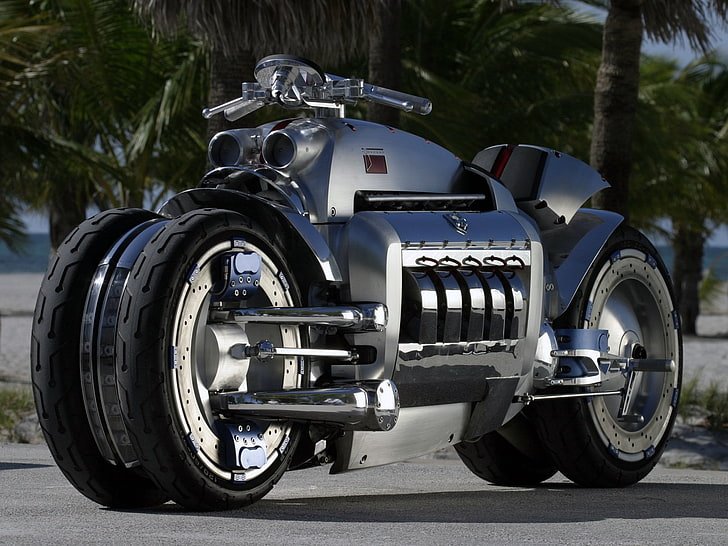
In 2003, at the Detroit Auto Show, Dodge unveiled something that didn’t fit any existing category. The Tomahawk looked like a motorcycle, sat like a motorcycle, and was steered like a motorcycle — except it had four wheels, weighed 680 kg, and carried a full 8.3-litre V10 engine borrowed straight from the Dodge Viper. Over two decades later, it’s still one of the strangest and most talked-about vehicles a major manufacturer has ever built.
The Story Behind the Tomahawk
The idea started as an internal joke that got out of hand. Around 2001, Chrysler employees Bob Schroeder and Dave Chyz wondered what it would be like to drop a Viper engine into a motorcycle frame. Chrysler Group’s design team, led by Mark Walters, ran with the concept, and what emerged was a machine Chrysler openly described as “a rolling sculpture” rather than a functional vehicle built explicitly to draw attention to the Dodge brand and showcase engineering ambition rather than to actually be ridden.
That framing matters, because it explains almost every strange decision that followed. The Tomahawk was never meant to be practical. It was meant to be a statement — proof that Chrysler’s engineers could take the most powerful engine in their lineup and force it into a form nobody had tried before. Trevor Creed, Chrysler’s Senior VP of Design at the time, described riding it as “grabbing and holding onto anything for dear life,” which tells you most of what you need to know about how seriously Dodge took the “safety” angle.
Getting the Viper V10 to fit meant re-engineering large parts of the engine itself. Dodge switched it to dry-sump lubrication to free up clearance, replaced the single front radiator with two smaller units mounted above the engine, and relocated the headlights to sit between the front wheels since there was nowhere else to put them. A standard motorcycle gearbox couldn’t handle the torque, so engineers built a custom foot-shifted, two-speed sequential racing transmission with a hand-operated clutch, sending power to the rear wheels through a motorcycle-style chain.
Engine, Performance & The Numbers Behind the Hype
On paper, the numbers are absurd for anything with two wheels, let alone four. The 8.3-litre V10 produced a claimed 500 hp and 525 lb-ft (712 Nm) of torque, giving the 680 kg Tomahawk a power-to-weight ratio that rivals modern hypercars. Dodge claimed a 0-60 mph time of roughly 2.5 seconds and a theoretical top speed of up to 420 mph — though this number was pure marketing extrapolation, not a tested figure. The most any engineer actually took the Tomahawk to during internal testing was 100 mph, and even that was reportedly enough to reveal serious stability concerns at speed.
That gap between claimed and tested performance is really the whole story of the Tomahawk. It was designed to generate headlines with numbers nobody could verify, precisely because nobody was ever going to push it to those limits. Four wheels, arranged in two closely spaced pairs with independent suspension, existed purely to manage the engine’s power delivery Chrysler COO Wolfgang Bernhard said outright that a conventional two-wheel motorcycle simply couldn’t handle that much torque.
Key Facts About the Dodge Tomahawk
- Powered by the third-generation 8.3-litre Viper V10, the same engine used in the 2003-2006 Viper SRT-10
- Custom two-speed sequential transmission, since a standard motorcycle gearbox couldn’t survive the torque
- Never certified street legal in any market
- Only 10 units were ever hand-built, sold as rolling sculpture rather than a functional vehicle
“A motorcycle is the most beautiful way to showcase an engine.” — Wolfgang Bernhard, Chrysler Group COO
Dodge Tomahawk Quick Specs
Quick Specs
Engine: 8.3L Viper V10
Power: 500 bhp
Torque: 712 Nm
Topspeed: 480 km/h (300 mph)
Weight: 680 kg (1500 lbs)
Verdict
The Dodge Tomahawk was never meant to make sense — it was meant to prove a point, and by that measure it succeeded completely. More than 20 years later, no manufacturer has attempted anything quite like it: a full-size V10 shoehorned into a motorcycle-shaped frame, sold not as transportation but as functional art. It’s a reminder that concept vehicles don’t always need a path to production to matter; sometimes the entire point is showing what’s technically possible, consequences be damned.