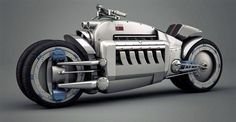
Dodge Tomahawk
Dodge Tomahawk Price
Approximate Ex-showroom Price
from Price on Request
Last Updated: August 2026
"The prices shown are Ex-showroom and approximate. They may vary or change without notice. Please confirm the latest price with your nearest authorized dealer."
Dodge Tomahawk Recent Updates
- No recent updates available
Interesting Facts
- Uses the largest production motorcycle engine ever made
- Named after its record-breaking top speed
- Only 10 units were ever built
- Took over 40 years to develop the platform
Dodge Tomahawk Variants
Dodge Tomahawk Key Specifications
 Engine
8277 cc
 Power
Power
500 bhp
 Torque
712 Nm
 Kerb Weight
680 kg
 Mileage
Not Specified
 Fuel Tank
12.7 ltrs | 3.4 gal
 Top Speed
480 km/h | 298 mph
 Transmission
2 Speed
Dodge Tomahawk Review
[+] Pros
- PRO_1
- Powered by a genuine 500 hp Viper V10 — unmatched output for anything resembling a motorcycle
- Custom-engineered two-speed transmission built specifically to handle the V10’s torque
- Claimed 0-60 mph of 2.5 seconds, extraordinary for its era
[-] Cons
- Never certified street legal in any market
Verdict
The Dodge Tomahawk was never meant to make sense as transportation, and judged as anything other than a rolling engineering statement, it doesn’t need to. Ten units, a Viper V10, and a claimed top speed nobody ever verified make it one of the most extreme “what if” projects a manufacturer has ever greenlit. It’s less a motorcycle you’d ever consider buying and more a piece of automotive folklore that happened to come with a price tag.
Reviewed by AutoMotoSpecs
Dodge Tomahawk Description
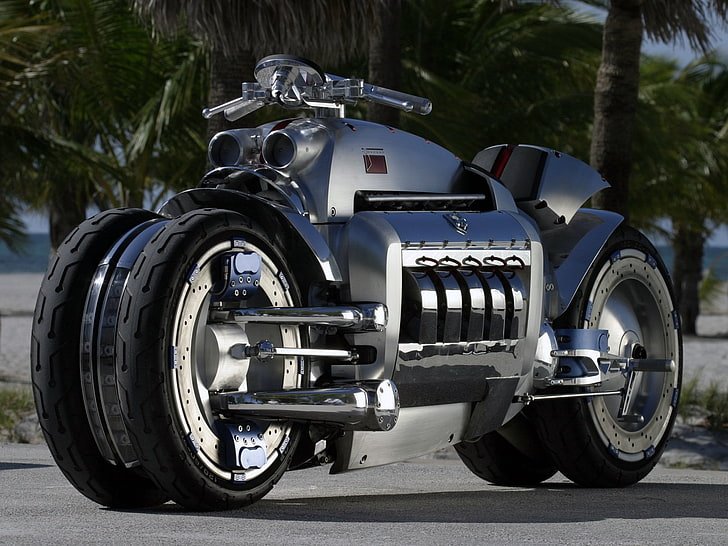
The Dodge Tomahawk is one of the most audacious concept vehicles a major manufacturer has ever built — a four-wheeled, motorcycle-styled machine powered by a full Dodge Viper V10 engine. Unveiled by Chrysler in 2003 and hand-built in extremely limited numbers, the Tomahawk was never intended as transportation. It was built to prove a point about what happens when engineers are given a blank check and told to build something nobody had attempted before, and to this day it remains one of the most powerful “motorcycles” ever produced, despite technically never being street legal anywhere in the world.
Engine and Performance
The Tomahawk is powered by the 8.3-litre V10 engine from the 2003-2006 Dodge Viper SRT-10, producing 500 hp and 525 lb-ft (712 Nm) of torque. Fitting a full-size car engine into a motorcycle-styled frame required real re-engineering: Dodge switched the engine to dry-sump lubrication to save clearance and replaced the Viper’s single front radiator with two smaller units mounted above the engine. A standard motorcycle gearbox couldn’t handle that much torque, so engineers built a custom two-speed sequential racing transmission with a hand-operated clutch, sending power to the rear wheels through a motorcycle-style chain drive.
Acceleration & Top Speed
Dodge claimed a 0-60 mph time of roughly 2.5 seconds, an extraordinary figure for a vehicle balanced on two closely spaced pairs of wheels. Top speed was marketed at up to 420 mph, but this was a theoretical extrapolation based on the engine’s power curve, not a tested figure. In practice, the most any engineer took the Tomahawk during internal testing was around 100 mph, and even that reportedly revealed real stability concerns at speed — a gap between claimed and tested performance that defines much of the Tomahawk’s story.
Design and Styling
Visually, the Tomahawk looks unmistakably like a motorcycle — a single saddle-style seat, exposed V10 engine dominating the frame, and motorcycle-style handlebars and instrumentation. What sets it apart is the wheel layout: four wheels arranged in two closely spaced pairs, one at the front and one at the rear, rather than the two wheels a real motorcycle would use. Headlights were relocated to sit between the front wheel pair, since there was nowhere else on the frame to put them.
Suspension and Handling
The four-wheel layout wasn’t a styling choice – it existed purely to manage the Viper V10’s torque output, which Chrysler’s engineers determined a conventional two-wheel motorcycle simply couldn’t handle safely. Each wheel pair uses independent suspension, giving the Tomahawk a genuinely unusual riding dynamic that blends motorcycle-style lean-in cornering with the added stability of four contact patches.
Wheels and Tyres
The Tomahawk runs on four narrow motorcycle-style wheels and tyres, paired front and rear, rather than the wide car tyres you’d expect given the power output. This setup was central to keeping the bike’s motorcycle character intact while still finding a way to put the V10’s power down.
Braking System
Braking duties are handled by a motorcycle-derived setup across all four wheels, engineered to manage stopping the Tomahawk’s 680 kg weight from the very high speeds its engine was theoretically capable of reaching.
Price and Exclusivity
Each Tomahawk was hand-built and sold for approximately $555,000 in 2003 — worth close to $950,000 today when adjusted for inflation. Only 10 units were ever produced, sold explicitly as rolling sculpture rather than a functional street vehicle, with nine going to private collectors and Chrysler retaining the tenth for its own museum. It still holds a Guinness World Record for the most powerful production motorcycle ever built.
Dodge Tomahawk Specifications & Features
Engine and Performance
Engine Type: V10 Engine
Engine Capacity: 8277
Max Power: 500 bhp @ 5,600 rpm
Torque: 712 Nm @ 4,200 rpm
Transmission: 2 speed
Cooling System: Twin aluminum radiators
Number of Valves: 20
Bore x Stroke: 102.4mm x 100.6mm
Compression Ratio: 9.6:1
Type of Clutch: Double-disc, dry plate
Assist & Slipper Clutch: Not Specified
Fuel Type: Petrol
Fuel System: sequential, multi-port electronic fuel injection
Fuel Tank Capacity: 12.7 ltrs | 3.35 gal
Mileage: Not Specified
Acceleration 0-100 km/h: 2.5 sec
Top Speed: 480 km/h | 300 mph
Emission Level: Not Specified
Suspension, Tyres, and Wheels
Front Suspension: Not Specified
Rear Suspension: Not Specified
Front Tyre: 20" x 4"
Rear Tyre: 20" x 5"
Tyre Type: Tubeless
Wheels: Not Specified
Swingarm: Not Specified
Braking System
Front Brakes: Not Specified
Rear Brake: Not Specified
ABS: Not Specified
Dimensions
Length: Not Specified
Width: Not Specified
Height: Not Specified
Wheelbase: Not Specified
Kerb Weight: 680 kg | 1500 lbs
Seat Height: Not Specified
Ground Clearance: Not Specified
Design
Body style: Not Specified
Winglet: Not Specified
Pillion Seat: No
Colours: 1 Colour
DRLs: Not Specified
Lighting: Not Specified
Features & Technology
Traction Control: Not Specified
Cruise Control: Not Specified
Launch Control: Not Specified
Steering Stabilizer: Not Specified
Slide Control: Not Specified
Wheelie Control: Not Specified
Hill Hold Control: Not Specified
Riding Modes: Not Specified
Power Modes: Not Specified
Quickshifter: Not Specified
Instrument Console: Not Specified
Smartphone Connectivity: Not Specified
Lap Timer: Not Specified
Gear Indicator: Not Specified
GPS / Navigation: Not Specified
USB Charging Port: Not Specified
Shift Light: Not Specified
Others
Others: Not Specified
Dodge Tomahawk Variants and Key Differences
Compare all Dodge Tomahawk variants side by side on engine, power, torque and kerb weight, with the key differences that set each version apart. Open any variant for its full specifications.
| Variant | Engine | Power | Torque | Kerb Weight | Key Differences | Page link |
|---|---|---|---|---|---|---|
| Dodge Tomahawk | 8277 cc | 500 bhp | 712 Nm | 680 kg | — |
Similar Bikes
Other Dodge Bikes
Dodge Tomahawk FAQs
An 8.3-litre V10 borrowed directly from the 2003-2006 Dodge Viper SRT-10, producing 500 hp and 525 lb-ft of torque.
Dodge claimed a theoretical top speed of up to 420 mph, though this was never actually tested.
Each unit sold for approximately $555,000 in 2003, equivalent to nearly $950,000 today.
No. It was never certified as street legal in any market and was sold explicitly as a display and collector’s piece rather than a rideable vehicle.
Only 10 units were ever produced.