ABS vs CBS: What’s the Real Difference, and Which Bikes Actually Need It?
Both promise safer braking, but ABS and CBS solve completely different problems — here’s how each system actually works, and why the rules around them just changed in India.
If you’ve shopped for a bike or scooter in India recently, you’ve almost certainly seen “ABS” and “CBS” listed as variant differences, usually with a price gap attached. They sound similar and both get marketed as safety features, but they solve completely different problems on completely different terms. Understanding which one actually matters for how you ride is the difference between paying for a feature you need and one that just sounds reassuring on a brochure.
How ABS and CBS Actually Work
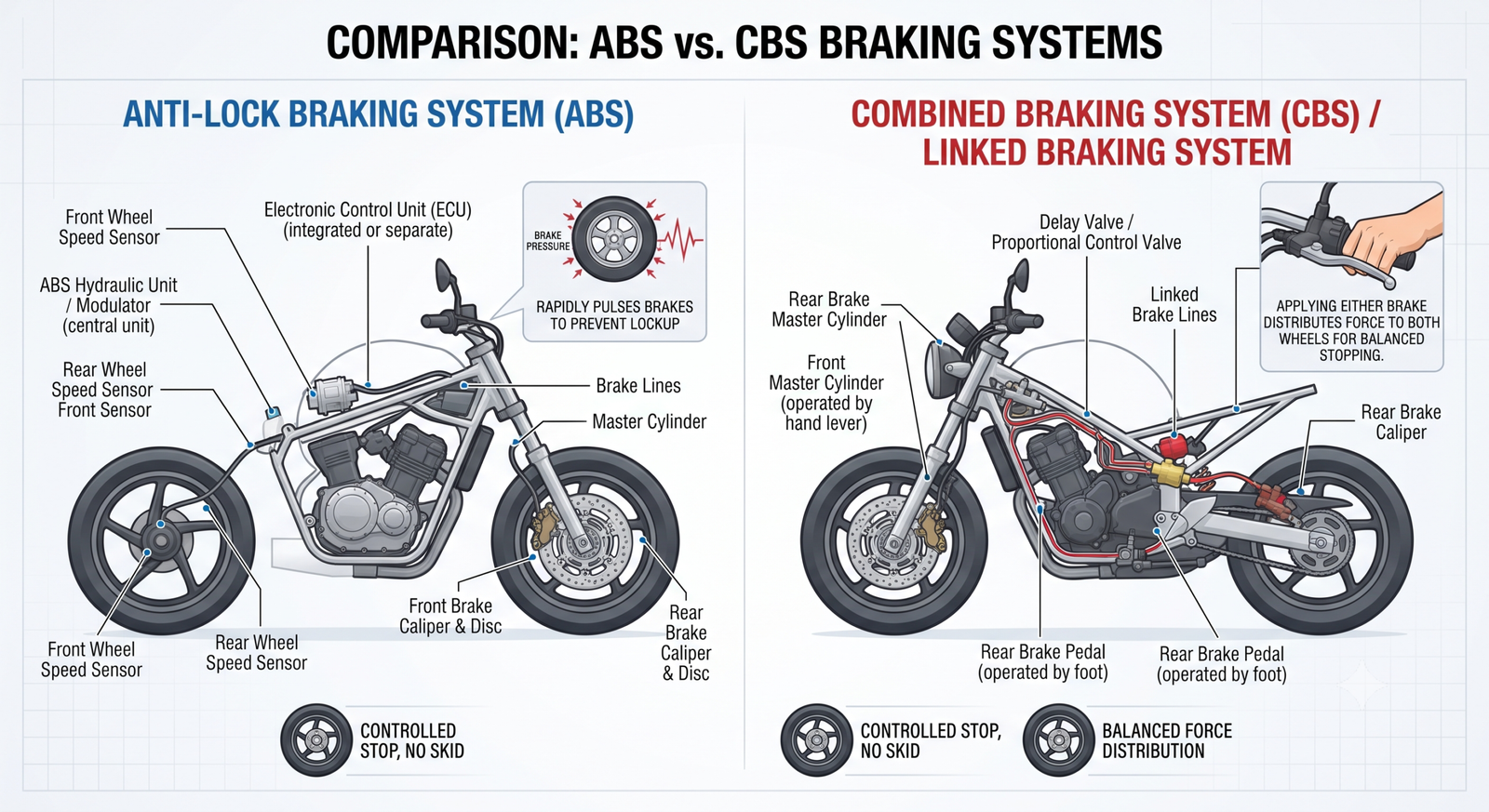
Anti-lock Braking System (ABS) prevents your wheels from locking up under hard braking. When you grab the brake lever aggressively — say, during an emergency stop — a locked wheel loses traction and starts skidding instead of slowing you down, which is exactly when a bike tends to slide out from under a rider. ABS uses wheel-speed sensors to detect the moment a wheel is about to lock, and rapidly pulses the brake pressure on and off, dozens of times per second, so the wheel keeps rotating just enough to maintain grip. You still stop fast, but you keep steering control while doing it.
Combined Braking System (CBS) solves a different, more basic problem: most riders, especially newer ones, instinctively grab the front brake hard and barely touch the rear, or ignore it completely. That’s a dangerous habit, because relying almost entirely on the front brake in a panic stop can pitch the bike forward and reduce overall stopping power. CBS fixes this by linking the two brakes together — squeeze either lever, and the system automatically applies a proportional amount of force to the other wheel too. It’s not preventing lock-up like ABS does; it’s just making sure both wheels are actually contributing to the stop.
The distinction that matters most: CBS is about brake distribution, ABS is about wheel lock-up prevention. A bike can have CBS and still skid its front wheel under hard braking on a wet road, because CBS does nothing to stop a locked wheel from losing traction. That’s precisely the gap ABS was designed to close.
Why the Rules Just Changed in India
Until recently, India followed a graduated rule: motorcycles above 125cc needed ABS, while smaller motorcycles and scooters could get away with CBS instead — a compromise built around keeping entry-level, price-sensitive bikes affordable. That changed with a new mandate covering all L2-category two-wheelers (anything above 50cc or capable of over 50 km/h), requiring ABS regardless of engine size, which came into force on January 1, 2026.
The mandate wasn’t uncontested. Manufacturers pushed back hard through 2025, arguing that ABS on small, low-speed commuter bikes adds real cost (estimates ranged from ₹3,000 to ₹6,000 per unit) without a proportional safety benefit, given how much of that segment operates at lower speeds where CBS was considered adequate. The government held its ground, and the rule went into effect on schedule — meaning CBS as a standalone braking solution is now effectively being phased out of new two-wheelers in India, with only the smallest sub-50cc mopeds and older existing stock still running on it.
What Actually Matters When You’re Choosing a Bike
- ABS prevents wheel lock-up and skidding; CBS only balances brake force between front and rear
- CBS still matters for sub 50cc mopeds/scooters and remains standard in several other markets
- CBS bikes are more affordable but don’t perform reliably on wet or loose surfaces during hard braking, since a locked wheel can still skid
- Single-channel ABS (front wheel only) is common and cheaper on entry-level bikes; dual-channel ABS (both wheels) offers the most control and is typically found on higher-capacity motorcycles
“ABS helps prevent wheel locking and slipping during emergency braking, thereby enhancing safety.” — Ministry of Road Transport and Highways guidance on the 2026 mandate
Quick Comparison
| Feature | ABS | CBS |
|---|---|---|
| What it does | Prevents wheel lock-up during hard braking | Balances brake force between front & rear |
| Best for | Emergency braking, wet/loose surfaces | New riders, uneven brake application |
| Cost impact | ₹3,000–6,000 added cost | Lower cost than ABS |
Verdict
If you’re buying a new two-wheeler above 50cc in India today, this decision has effectively been made for you — ABS is now standard, and CBS-only variants are on their way out for anything beyond the smallest mopeds. But understanding the actual difference still matters: ABS is the system doing the real work in an emergency stop, especially on wet roads or loose gravel, while CBS was always a stopgap for riders who don’t brake with both hands and feet the way they should. If you’re shopping in a market where both are still offered side by side, don’t treat them as interchangeable safety badges — only one of them is actually preventing your wheel from locking up.